Tom Harper, speaking of the Cheney administration being put on the defensive, notes that Murtha is going to be swiftboated, and "...millions of gullible Americans will probably think he burned his draft card during the Vietnam war and his hobbies include torturing fetuses..."
My thanks for the reminder of something we too easily forget: the Republicans recognize that there are some groups whom it is just plain wrong to torture.


Something humorous, but lingering
with either boiling oil or melted lead.
But since I can't administer the proper retribution to spambots, I'm reduced to installing the clever Turing keyword test on comments.
But since I can't administer the proper retribution to spambots, I'm reduced to installing the clever Turing keyword test on comments.
Set the goddam increment bit!
Despite the title, no deep technoid stuff here. If you've read this far, read on. This is too good to be true, almost:
By now everyone has heard about the worm that Sony put on a bunch of its plain audio CDs, which installs itself invisibly in the Windows kernel via some nice security hole that Microsoft left for such purposes. And everyone has heard how within a couple of days of the announcement some malware writers had started circulating stuff that exploited the Sony exploit to get their own evil stuff into Windows in a way that's next to impossible to delete.
Hmm, I said no technoid stuff, didn't I? Gimme a break; the press handles stories like this every day.
All right, the code that Sony installs on your XP system, designed toprotect their copyright prevent you from exercising legitimate rights under copyright law is a copyright violation! Thanks to Rachel for this one. There is code in Sony's little production that's identical to code in LAME, an open-source mp3 encoder.
Open source? Doesn't that mean it's OK to use the code? Yes; everyone is free to use it in accord with the terms of the license under which it's distributed. That's the Gnu Lesser General Public License, and it requires, as they clearly explain in their documentation, that you must give them due credit, provide a link back to their website, and make your modifications to their code available under the GNU license. Want to guess how much of this Sony has done?
It appears that if copyright law is worth anything, Sony, having simply lifted the code without any compliance with license terms, is subject to a nasty lawsuit. To be sure, Gnu's GPL has not yet been tested in court. When do we start? Where's the signup sheet for backers for legal expenses?
Speaking of GPL: Thirty-some years ago, I worked for a company called Information Systems Design, which at one point was involved in one of the first publicized cases of theft of software, and the first application of a new California law on theft of trade secrets. We were the good guys, of course. A competitor who couldn't solve a problem that one of our guys had figured out took a simpler approach: steal our code. We found out; the cops and the Santa Clara County D.A. were quite happy to take on the first test case for the new criminal law; they got a warrant and staged a raid, with technical ssistance from us.
I'd love to tell the full tale, including the first broad search warrant to search all of a computer installation's magnetic storage, and how the story suddenly broke into international fame through a headline in the Chronicle; but I'm too lazy right now. And this isn't supposed to get tech-heavy.
But one thing we had to prove in court, naturally, was that the code they had was actually stolen from us and wasn't an independent solution to the same problem. (The LAME people will have the same problem, which they can easily solve because there is plenty of stuff visible on Sony's CDs which resembles their code in ways that can't possibly be coincidental.) So the competitor's code was examined by the author of our code, to look for excessive resemblances, of which he found plenty. One example that got into the court records concerned a line from which he had at an early stage omitted an essential asterisk, causing the code not to work properly. Finding the error, he had gone back and fixed it. And as he did so, Greg Lutz (who used his initials GPL on his code submissions -- how's that for uncanny?) added this comment.
SET THE GODDAM INCREMENT BIT
Oddly enough, the same comment appeared verbatim in the other guys' code. The perp copped a plea, and we won our lawsuit.
By now everyone has heard about the worm that Sony put on a bunch of its plain audio CDs, which installs itself invisibly in the Windows kernel via some nice security hole that Microsoft left for such purposes. And everyone has heard how within a couple of days of the announcement some malware writers had started circulating stuff that exploited the Sony exploit to get their own evil stuff into Windows in a way that's next to impossible to delete.
Hmm, I said no technoid stuff, didn't I? Gimme a break; the press handles stories like this every day.
All right, the code that Sony installs on your XP system, designed to
Open source? Doesn't that mean it's OK to use the code? Yes; everyone is free to use it in accord with the terms of the license under which it's distributed. That's the Gnu Lesser General Public License, and it requires, as they clearly explain in their documentation, that you must give them due credit, provide a link back to their website, and make your modifications to their code available under the GNU license. Want to guess how much of this Sony has done?
It appears that if copyright law is worth anything, Sony, having simply lifted the code without any compliance with license terms, is subject to a nasty lawsuit. To be sure, Gnu's GPL has not yet been tested in court. When do we start? Where's the signup sheet for backers for legal expenses?
Speaking of GPL: Thirty-some years ago, I worked for a company called Information Systems Design, which at one point was involved in one of the first publicized cases of theft of software, and the first application of a new California law on theft of trade secrets. We were the good guys, of course. A competitor who couldn't solve a problem that one of our guys had figured out took a simpler approach: steal our code. We found out; the cops and the Santa Clara County D.A. were quite happy to take on the first test case for the new criminal law; they got a warrant and staged a raid, with technical ssistance from us.
I'd love to tell the full tale, including the first broad search warrant to search all of a computer installation's magnetic storage, and how the story suddenly broke into international fame through a headline in the Chronicle; but I'm too lazy right now. And this isn't supposed to get tech-heavy.
But one thing we had to prove in court, naturally, was that the code they had was actually stolen from us and wasn't an independent solution to the same problem. (The LAME people will have the same problem, which they can easily solve because there is plenty of stuff visible on Sony's CDs which resembles their code in ways that can't possibly be coincidental.) So the competitor's code was examined by the author of our code, to look for excessive resemblances, of which he found plenty. One example that got into the court records concerned a line from which he had at an early stage omitted an essential asterisk, causing the code not to work properly. Finding the error, he had gone back and fixed it. And as he did so, Greg Lutz (who used his initials GPL on his code submissions -- how's that for uncanny?) added this comment.
SET THE GODDAM INCREMENT BIT
Oddly enough, the same comment appeared verbatim in the other guys' code. The perp copped a plea, and we won our lawsuit.
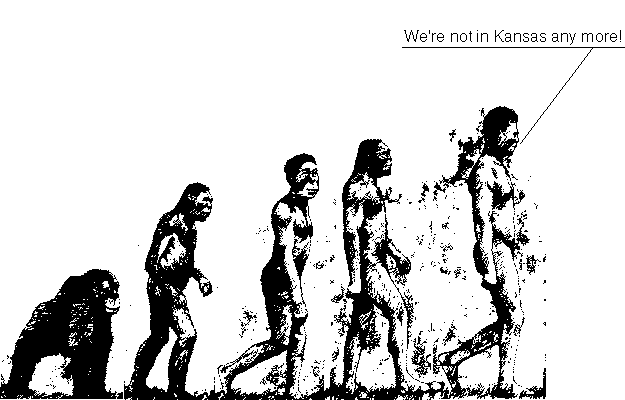
Kansas? Again?
Kansas puts us in touch with the eternal verities. Like, what goes around comes around.. Like, if you put a stupid topical joke on your website and never update anything, after a while it's topical again.
Are seven syllables really enough?
Dadahead has a post on Andy Rooney and Don Imus talking about "black" and "African American". I have no real problem with his conclusions, and no idea of defending R & I; but there's more to be said.
First off, people are in fact trying to tell me (along with Rooney and Imus) how I ought to use my native language. Many people object to being told that kind of thing. They are wrong; but not quite completely wrong.
People have a right, within some limits, to decide what they are to be called. When Clive Staples Lewis, aged 7 or so, declares that from now on he is Jack, the members of his family go along with it; and for the rest of his life he is Jack to all his friends. (Sure beats Clive, even though he was not named after the imperialist.)
And if an identifiable group makes a collective decision on what it's to be called -- you know it's identifiable because it is identified by some name or other -- that decision is to be heeded, other things being equal or nearly so. There will be objections at this point that "collective decision" is impossible and oxymoronic. Strictly speaking, yes, it's impossible, but I know one when I see one.
I saw one in the 1960s. When I learned the English language, the word Negro was used in my part of the world by decent people , by which I mean people who were not overtly racist, did not want to be racist, and did not like racism, however far they may have been from the impossible dream of really being free from racism. There were other words, to be sure.
One word was not used, and that's that. (It's rather an open secret that the word is used in ceratin contexts by members of the group. That's their privilege. This annoys a lot of stupid whiny honkies -- I claim the privilege of using that term -- but to hell with them.)
There was "colored". I'm not quite sure what was wrong with it, but it was not what one used. I think it seemed rather patronizing and euphemistic. Euphemistic? You mean there's something wrong with being [black/Negro/colored]? Of course not; it sounds as if the speaker thinks there's something wrong with it: that's the patronizing part. But I don't insist on the point.
There was also "black". Sounded a bit dubious. Makes one think of Little Black Sambo. And let's please not get into whether Sambo must have been Indian if he dealt with tigers, if only because that will remind us to start fighting about the terminology for the descendants of the the pre-Columbian inhabitants of the Americas, exluding Eskimos, oooooops, Inuit. Anyway, it didn't sound right to me.
And then in the '60s there was a rather sudden collective decision, I know one when I see one, to make a change. From then on, the word was to be "Black". Jules Feiffer did a typically funny sarcastic treatment of Black, and it was right, but in the long run irrelevant. And it seemed to me that rather a lot of the older generation of Negroes did not like the new name much more than I did, but they saw which way things were going, and fighting about it was not what they needed, and they swallowed their discomfort. (I could be all wrong about that, and I certainly have no authority here, but so it seemed to me at the time.)
And I went along, of course, because people have a right to choose what they are called, within some limits of reason, and all the more so when they've been taking inconceivable amounts of shit for hundreds of years. And by golly, pretty soon Black sounded right. And in not too many years, Negro actually sounded a bit embarrassing.
And now we come to "African American", with or without a hyphen. Someone is telling me that I ought to change my vocabulary again, and I am to decide whether to do it this time.
To begin with, I've already changed once, by request. Are names to be changed every so often, with the season's fashions? Right, that's an old guy's sort of argument, and the young and flexible people may well want to make the change immediately. (They, of course, would be making it for the first time.) And it's a small sort of request to make of one's friends and family; if my cousin, whose legal birth-certificate name I had almost forgotten at one time, told me that her first name was changing again from the one that I've used almost all our lives, it would change, blood being thicker than water. But it takes a bit more presumption to keep shaping the vocabulary of millions of strangers.
And just who is telling me? I do not sense the consensus that I did 40 years go, or anything like it. I could be wrong, but I don't see it.
And I am expected to change a good solid forceful one-syllable English word to a nasty heptasyllabic compound, no more sensible or meaningful than the thoroughly inaccurate "black". I don't see the purpose. Or rather, I do see the political purpose, and I disagree with it.
Dadahead says that "African American" signals that you are trying to be sensitive about these things, and that's true and good. He says that it offends no one; in effect, that it's neutral. I disagree on that. Aha! I found something to disagree with, justifying the existence of this posting.
First off, people are in fact trying to tell me (along with Rooney and Imus) how I ought to use my native language. Many people object to being told that kind of thing. They are wrong; but not quite completely wrong.
People have a right, within some limits, to decide what they are to be called. When Clive Staples Lewis, aged 7 or so, declares that from now on he is Jack, the members of his family go along with it; and for the rest of his life he is Jack to all his friends. (Sure beats Clive, even though he was not named after the imperialist.)
And if an identifiable group makes a collective decision on what it's to be called -- you know it's identifiable because it is identified by some name or other -- that decision is to be heeded, other things being equal or nearly so. There will be objections at this point that "collective decision" is impossible and oxymoronic. Strictly speaking, yes, it's impossible, but I know one when I see one.
I saw one in the 1960s. When I learned the English language, the word Negro was used in my part of the world by decent people , by which I mean people who were not overtly racist, did not want to be racist, and did not like racism, however far they may have been from the impossible dream of really being free from racism. There were other words, to be sure.
One word was not used, and that's that. (It's rather an open secret that the word is used in ceratin contexts by members of the group. That's their privilege. This annoys a lot of stupid whiny honkies -- I claim the privilege of using that term -- but to hell with them.)
There was "colored". I'm not quite sure what was wrong with it, but it was not what one used. I think it seemed rather patronizing and euphemistic. Euphemistic? You mean there's something wrong with being [black/Negro/colored]? Of course not; it sounds as if the speaker thinks there's something wrong with it: that's the patronizing part. But I don't insist on the point.
There was also "black". Sounded a bit dubious. Makes one think of Little Black Sambo. And let's please not get into whether Sambo must have been Indian if he dealt with tigers, if only because that will remind us to start fighting about the terminology for the descendants of the the pre-Columbian inhabitants of the Americas, exluding Eskimos, oooooops, Inuit. Anyway, it didn't sound right to me.
And then in the '60s there was a rather sudden collective decision, I know one when I see one, to make a change. From then on, the word was to be "Black". Jules Feiffer did a typically funny sarcastic treatment of Black, and it was right, but in the long run irrelevant. And it seemed to me that rather a lot of the older generation of Negroes did not like the new name much more than I did, but they saw which way things were going, and fighting about it was not what they needed, and they swallowed their discomfort. (I could be all wrong about that, and I certainly have no authority here, but so it seemed to me at the time.)
And I went along, of course, because people have a right to choose what they are called, within some limits of reason, and all the more so when they've been taking inconceivable amounts of shit for hundreds of years. And by golly, pretty soon Black sounded right. And in not too many years, Negro actually sounded a bit embarrassing.
And now we come to "African American", with or without a hyphen. Someone is telling me that I ought to change my vocabulary again, and I am to decide whether to do it this time.
To begin with, I've already changed once, by request. Are names to be changed every so often, with the season's fashions? Right, that's an old guy's sort of argument, and the young and flexible people may well want to make the change immediately. (They, of course, would be making it for the first time.) And it's a small sort of request to make of one's friends and family; if my cousin, whose legal birth-certificate name I had almost forgotten at one time, told me that her first name was changing again from the one that I've used almost all our lives, it would change, blood being thicker than water. But it takes a bit more presumption to keep shaping the vocabulary of millions of strangers.
And just who is telling me? I do not sense the consensus that I did 40 years go, or anything like it. I could be wrong, but I don't see it.
And I am expected to change a good solid forceful one-syllable English word to a nasty heptasyllabic compound, no more sensible or meaningful than the thoroughly inaccurate "black". I don't see the purpose. Or rather, I do see the political purpose, and I disagree with it.
Dadahead says that "African American" signals that you are trying to be sensitive about these things, and that's true and good. He says that it offends no one; in effect, that it's neutral. I disagree on that. Aha! I found something to disagree with, justifying the existence of this posting.
The Poetry Corner
Grand Moff Texan is rising to new poetic heights in response to the current pony-fest. With a bit of formatting for clarification:
This is what's left of the right. [Already a good line!]
They're willing to sneak around and slit throats in the night,
but they don't have the guts for a straight up fight.
Can they draw a goose, too?
Again, bottleofblog sends me to an important story, this on the chilling letter from the Number 2 man in Al Qaeda.
Bottle, after guaranteeing that the reader of the letter will remain so unchilled as practically to be sweaty, comments on the remarkable number of number-2 men Al Qaeda has.
I'm mainly reminded of Robert Benchley.
This letter is so chilling, says the story, because of how "calm, clear, and well argued" it is. Isn't it remarkable? A senior leader at Al Qaeda can write a letter clearly! And "Isn't It Remarkable?" was the title of the essay Benchley wrote when he encountered a picture captioned "Remarkably Accurate and Artistic Painting of a Goose from Pharoah Akhenaten's Palace, Drawn 3300 Years Ago." Benchley asked why it was remarkable: "Why should we be surprised that the people who built the Pyramids could also draw a goose so that it looked like a goose?"
Benchley's sobering essay (or chilling?) should be read, for balance, along with his "Lucky World!" which begins, "When you come to think of it, the wonder is not that there are so many jammed automobile fenders, bad motion pictures, sore throats, divorces and wars, but that there aren't more of them." Both are in My Ten Years in a Quandary, Harper & Bros, 1936 (lots of reprints, cheap at abebooks.
Bottle, after guaranteeing that the reader of the letter will remain so unchilled as practically to be sweaty, comments on the remarkable number of number-2 men Al Qaeda has.
I'm mainly reminded of Robert Benchley.
This letter is so chilling, says the story, because of how "calm, clear, and well argued" it is. Isn't it remarkable? A senior leader at Al Qaeda can write a letter clearly! And "Isn't It Remarkable?" was the title of the essay Benchley wrote when he encountered a picture captioned "Remarkably Accurate and Artistic Painting of a Goose from Pharoah Akhenaten's Palace, Drawn 3300 Years Ago." Benchley asked why it was remarkable: "Why should we be surprised that the people who built the Pyramids could also draw a goose so that it looked like a goose?"
Benchley's sobering essay (or chilling?) should be read, for balance, along with his "Lucky World!" which begins, "When you come to think of it, the wonder is not that there are so many jammed automobile fenders, bad motion pictures, sore throats, divorces and wars, but that there aren't more of them." Both are in My Ten Years in a Quandary, Harper & Bros, 1936 (lots of reprints, cheap at abebooks.
Another hero gone
Vivian Jones; R. I. P. Thanks to bottleofblog. Apologies for pointing people to so much bad language lately; but bottle's caption to her picture should be in textbooks to illustrate the distinction between indecorous and disrespectful.
Paradise Lost, the Movie
No, really.
Or should that be John Milton's Paradise Lost as with Frankenstein?
But what you must not miss is the comments. Unless (spoiler) you just don't care about David Mamet.
Or should that be John Milton's Paradise Lost as with Frankenstein?
But what you must not miss is the comments. Unless (spoiler) you just don't care about David Mamet.
Hoping Tom Lehrer saw the item
Great news. There is now a proper explanation for short gamma-ray bursts. In case you missed out, these are short bursts of high-energy radiation from somewhere in the sky, which satellite devices started picking up several years ago; the atmosphere blocks the gamma radiation from getting down here. While it's flashing ("short" means less than two seconds), a burst is as bright as 100 quadrillion Suns.
BTW, this is the second time in a couple of days that I've seen a number like "100,000 trillion". What gives? Thousand million and million million have passed pretty well out of the language, especially since England decided to join Germany and the USA in defining billion and trillion, eliminating a possible ambiguity. Can it be that the reader isn't expected to know what a quadrillion is? Answer, I suppose: Until recently, trillions were something a person just hadn't heard of, except perhaps in the number of miles in a light-year; the latter was usually called six million million miles when I first heard the number, fifty-some years ago (finding the locution annoying even then). What with GDPs and national debts and national budgets, not to mention big amounts of money denominated in Yen, trillions are now considered familiar enough to use, but it will be a few years before even the US war budget hits a quadrillion Yen.
Oh, right, you want to know what does cause these things. Colliding neutron stars, according to the paper coming out today in Nature. (Subscription required, of course.) There's a mind-blowing thought. Also, a good name for a rock group.
It has been known for some time that these big explosions were a long way off. Good thing. If one happened in our galaxy, and the beam of gamma radiation happened to point our way, it could knock out the ozone layer completely, causing us all to be fried with short-wave unltraviolet from our friendly neighborhood Sun. Unlikely, however, so "don't buy gamma ray burst insurance," says Edward "Rocky" Kolb of Fermilab.
Besides,
BTW, this is the second time in a couple of days that I've seen a number like "100,000 trillion". What gives? Thousand million and million million have passed pretty well out of the language, especially since England decided to join Germany and the USA in defining billion and trillion, eliminating a possible ambiguity. Can it be that the reader isn't expected to know what a quadrillion is? Answer, I suppose: Until recently, trillions were something a person just hadn't heard of, except perhaps in the number of miles in a light-year; the latter was usually called six million million miles when I first heard the number, fifty-some years ago (finding the locution annoying even then). What with GDPs and national debts and national budgets, not to mention big amounts of money denominated in Yen, trillions are now considered familiar enough to use, but it will be a few years before even the US war budget hits a quadrillion Yen.
Oh, right, you want to know what does cause these things. Colliding neutron stars, according to the paper coming out today in Nature. (Subscription required, of course.) There's a mind-blowing thought. Also, a good name for a rock group.
It has been known for some time that these big explosions were a long way off. Good thing. If one happened in our galaxy, and the beam of gamma radiation happened to point our way, it could knock out the ozone layer completely, causing us all to be fried with short-wave unltraviolet from our friendly neighborhood Sun. Unlikely, however, so "don't buy gamma ray burst insurance," says Edward "Rocky" Kolb of Fermilab.
Besides,
No one will have the endurance
To collect on his insurance,
Lloyd's of London will be loaded when they go.
Not Fine, thank you
Magnificent is better than Important. We no longer do Fine.
--Overheard at Christies: the official hermeneutics of the titles given to auctions.
--Overheard at Christies: the official hermeneutics of the titles given to auctions.
He lies like an eyewitness
The late Professor Bergen Evans of Northwestern University wrote two debunking books in the 1950s, The Natural History of Nonsense and The Spoor of Spooks, both of which will repay reading after 50 years. Too early for von Daeniken and spoon bending, but those are kind of out of date by now anyway, aren't they? But astrology and psi powers and misconceptions of history and law go on forever; and Evans will show you how little change there is in Things of Permanent Value like these.
When speaking of law and evidence, Evans cites a saying that he says is common among police and lawyers: "He lies like an eyewitness." Unless I am getting it all wrong (impossible, as I'm getting the information from The Guardian), we have a truly classic case concerning the man recentlly executed in London for the crime of Looking As If You Might Be Muslim.
(Now I'm the one that's lying. The soldier who was on stakeout classified him as White when he saw him leave the building. In a picture in The Observer today (21 Aug, but I can't find it on the website) he looks as Muslim or Asian (not to say African, which the actual suspect was) as I do. But at the time we thought that was part of his crime.)
We all knew how he was wearing unreasonably bulky clothes in warm weather; it looked as if there were wires and things sticking out of the clothes; he ran into the station pursued by numerous heavily-armed police and jumped the barrier, as the cops also did, sensibly enough; and so on.
I suspect, from a conversation or two, that the English, with their tradition of law-abiding police, do not fully grasp the distinction between running away from a real policeman wearing a friendly Bobby-helmet and running from a couple of armed goons, looking like anybody else or worse, who may or may not identify themselves verbally as being on the payroll of a police organization and may or not be speaking the truth. There will be plenty more opportunities to learn; September 11 has changed everything. But in the July accounts of the matter, there was no mistaking that these guys were Government; at least, if you are used to a country in which large gangs of heavily armed men are not the norm.
This week we learned that that story was a lie from beginning to end. One bit was related to the truth: after walking calmly into the station and stopping to pick up a free newspaper, he ran for the train. To be sure, we know that no Englishman would do that, but he was, alas, an Illegal Alien who didn't know better. Right.
All Americans understand this: the story was the standard set of police lies to cover up a criminal dereliction of duty. Well, all Americans who aren't complete drooling idiots. Nothing new here, except that this was maybe beyond the expected American norm for police malfeasance. And maybe that gives us an excuse, along with a general trust in British legal institutions, for our believing the whole story and interpreting the incident in terms of it.
But wait! Here comes the surprise: it was not a police fabrication. It was the eyewitness account of one Christopher Wells (along with one or two others), who was right there on the train and saw it all with completely unbiased eyes. (You'll have to read down to near the end of the story to find this.)
The officials in London are thinking hard about the case, and may come up with better solutions to operational control of these dangerous operations, and even to a problem which they had quite brilliantly kept irrelevant for a copule of centuries, how to manage trigger-happy cops. The rest of us can relearn a lesson about eyewitness accounts rendered by whatever self-aggrandizing fabulist may have happened to be on the site.
Oh, and Mr. Wells should call some Yank talk-radio site, which will surely be glad to give him a hero's tour of Red-State America.
When speaking of law and evidence, Evans cites a saying that he says is common among police and lawyers: "He lies like an eyewitness." Unless I am getting it all wrong (impossible, as I'm getting the information from The Guardian), we have a truly classic case concerning the man recentlly executed in London for the crime of Looking As If You Might Be Muslim.
(Now I'm the one that's lying. The soldier who was on stakeout classified him as White when he saw him leave the building. In a picture in The Observer today (21 Aug, but I can't find it on the website) he looks as Muslim or Asian (not to say African, which the actual suspect was) as I do. But at the time we thought that was part of his crime.)
We all knew how he was wearing unreasonably bulky clothes in warm weather; it looked as if there were wires and things sticking out of the clothes; he ran into the station pursued by numerous heavily-armed police and jumped the barrier, as the cops also did, sensibly enough; and so on.
I suspect, from a conversation or two, that the English, with their tradition of law-abiding police, do not fully grasp the distinction between running away from a real policeman wearing a friendly Bobby-helmet and running from a couple of armed goons, looking like anybody else or worse, who may or may not identify themselves verbally as being on the payroll of a police organization and may or not be speaking the truth. There will be plenty more opportunities to learn; September 11 has changed everything. But in the July accounts of the matter, there was no mistaking that these guys were Government; at least, if you are used to a country in which large gangs of heavily armed men are not the norm.
This week we learned that that story was a lie from beginning to end. One bit was related to the truth: after walking calmly into the station and stopping to pick up a free newspaper, he ran for the train. To be sure, we know that no Englishman would do that, but he was, alas, an Illegal Alien who didn't know better. Right.
All Americans understand this: the story was the standard set of police lies to cover up a criminal dereliction of duty. Well, all Americans who aren't complete drooling idiots. Nothing new here, except that this was maybe beyond the expected American norm for police malfeasance. And maybe that gives us an excuse, along with a general trust in British legal institutions, for our believing the whole story and interpreting the incident in terms of it.
But wait! Here comes the surprise: it was not a police fabrication. It was the eyewitness account of one Christopher Wells (along with one or two others), who was right there on the train and saw it all with completely unbiased eyes. (You'll have to read down to near the end of the story to find this.)
The officials in London are thinking hard about the case, and may come up with better solutions to operational control of these dangerous operations, and even to a problem which they had quite brilliantly kept irrelevant for a copule of centuries, how to manage trigger-happy cops. The rest of us can relearn a lesson about eyewitness accounts rendered by whatever self-aggrandizing fabulist may have happened to be on the site.
Oh, and Mr. Wells should call some Yank talk-radio site, which will surely be glad to give him a hero's tour of Red-State America.
The very last Terry Schiavo item
One should let the poor woman die and rest. Yes. And that is done.
But the case--is that laid to rest? Not yet: Governor Voodoo-Medicine so loved it that he brought it back for one more bow as a zombie. Now you've seen the news stories about how his Attorney General has dropped the case, and that's all. Isn't it?
Do you really think you can bury one of the Undead without bothering to put the stake through its heart? Out of boredom and perhaps even decency, the respectable media are trying to do that. But maybe the thing will stay buried longer if people see what the AG said. Thanks to JRH (and thanks to Shakespeare's Sister for pointing me to his blog), you can read the handwriting on the stake.
I'd take exception to JRH's description of the tone, which he says sounds like a lecture. The affect of the piece (as we 18th-century music types like to say) is not pure academic exposition; it is exasperation. Here you can find out how, if you are a lawyer holding a responsible office, speaking with dignity and coherence and full backing of evidence, you pronounce B-U-L-L-S-H-I-T.
But the case--is that laid to rest? Not yet: Governor Voodoo-Medicine so loved it that he brought it back for one more bow as a zombie. Now you've seen the news stories about how his Attorney General has dropped the case, and that's all. Isn't it?
Do you really think you can bury one of the Undead without bothering to put the stake through its heart? Out of boredom and perhaps even decency, the respectable media are trying to do that. But maybe the thing will stay buried longer if people see what the AG said. Thanks to JRH (and thanks to Shakespeare's Sister for pointing me to his blog), you can read the handwriting on the stake.
I'd take exception to JRH's description of the tone, which he says sounds like a lecture. The affect of the piece (as we 18th-century music types like to say) is not pure academic exposition; it is exasperation. Here you can find out how, if you are a lawyer holding a responsible office, speaking with dignity and coherence and full backing of evidence, you pronounce B-U-L-L-S-H-I-T.
Moratorium?
Kevin Drum made a very decent and reasonable suggestion that all the blogosphere should lay off the politicking, the "political point scoring over the London attacks. Just for a day." Other good people followed.
Dadahead thinks otherwise, that politics is not a parlor game, but a matter of life and death. He's right. Of course the Right came out running in all directions and screaming political obscenities, and that would make it harder to behave oneself; but that's not the point.
The rules naturally do not apply so strictly to those who are there and suffering. And the one about jokes doesn't apply at all to Londoners, God bless 'em, who, it's said, were coming up with jokes two hours after the bombs went off.
Back here where nobody's getting hurt, Debra Saunders, our own aspiring Michelle Malkin clone, really rose to the occasion. Read it yourself if you're a masochist. Her general idea is that if the people who bomb Planned Parenthood offices and murder doctors were to do something this bad to us, we Liberals would can all this dumb civil liberties stuff and understanding-the-reasons, and we'd go and hang us some Christians from the nearest lamppost. At least, that's what's implied by her knowledge that we'd have the sense to go out and kill somebody who's somehow vaguely or tenuously or fictitiously connected with the crime, the way she wants to do and George does. Perhaps she's mistaken.
So you can tell, the day is over. Now I want to ask anyone who has the stomach to follow these things: did someone, somewhere on the Right, say anything decent yesterday? There is a sort of Anglophilia that's obligatory in the respectable Right, after all; so, was anyone at the National Review, or a Boston brahmin who speaks only to Cabots or possibly to God, or a pillar of the Eastern prep schools, or any of the people who love Winston Churchill not only for saving civilization but for trying to preserve the Empire in India and upholding the Gold Standard, moved to express himself about England, and London, even before thinking what a good time it would be to buy on the market's downtick or writing about how it all proved that Liberals are evil?
Lefties who have no use for aristocracy or empire were moved to express themselves about the sceptered isle with Shakespeare's help, or on their own (see below). Surely some Righties did the same; I'd be glad to hear about it.
Meanwhile, are the terrorists getting it wrong? New York is not the first place to choose if you want to imtimidate people or drive them to despair. Lots of media action, but quite disappointing effects as to toppling New York. Or London! The Blitz (42,000 dead) and the past 30 years of terrorism from their own archipelago: a great prospect for demoralization and chaos there.
And I can't write Madrilenos without hearing:
Madrid, qué bien resistes,
Madrid, qué bien resistes,
Madrid, qué bien resistes,
mamita mía,
los bombardeos.
los bombardeos.
De las bombas se ríen,
de las bombas se ríen,
de las bombas se ríen,
mamita mía,
los madrileños.
los madrileños.
Well, they didn't laugh at the bombs in Madrid; but there's something about these cities that's hard to beat down. (Text is from "Los Cuatro Generales", song from the Spanis Civil War.)
Dadahead thinks otherwise, that politics is not a parlor game, but a matter of life and death. He's right. Of course the Right came out running in all directions and screaming political obscenities, and that would make it harder to behave oneself; but that's not the point.
'Politics' is, for most of us, simply the practice of critically analyzing the most important issues of our time. Asking us to put aside politics for the day is tantamount to calling for a moratorium on rational thought.It's not too early, though, to think about what one will do the next time. Here is a modest proposwal that would show respect for the dead and for the living. For one day, anyway: No gloating; no invective; no demonstrating how your favorite irrelevant issue is proved by the day's unpleasant events; no clever jokes, please.
Which, of course, is precisely what the Right would like, and precisely what they got in the aftermath of 9/11.
The rules naturally do not apply so strictly to those who are there and suffering. And the one about jokes doesn't apply at all to Londoners, God bless 'em, who, it's said, were coming up with jokes two hours after the bombs went off.
Back here where nobody's getting hurt, Debra Saunders, our own aspiring Michelle Malkin clone, really rose to the occasion. Read it yourself if you're a masochist. Her general idea is that if the people who bomb Planned Parenthood offices and murder doctors were to do something this bad to us, we Liberals would can all this dumb civil liberties stuff and understanding-the-reasons, and we'd go and hang us some Christians from the nearest lamppost. At least, that's what's implied by her knowledge that we'd have the sense to go out and kill somebody who's somehow vaguely or tenuously or fictitiously connected with the crime, the way she wants to do and George does. Perhaps she's mistaken.
So you can tell, the day is over. Now I want to ask anyone who has the stomach to follow these things: did someone, somewhere on the Right, say anything decent yesterday? There is a sort of Anglophilia that's obligatory in the respectable Right, after all; so, was anyone at the National Review, or a Boston brahmin who speaks only to Cabots or possibly to God, or a pillar of the Eastern prep schools, or any of the people who love Winston Churchill not only for saving civilization but for trying to preserve the Empire in India and upholding the Gold Standard, moved to express himself about England, and London, even before thinking what a good time it would be to buy on the market's downtick or writing about how it all proved that Liberals are evil?
Lefties who have no use for aristocracy or empire were moved to express themselves about the sceptered isle with Shakespeare's help, or on their own (see below). Surely some Righties did the same; I'd be glad to hear about it.
Meanwhile, are the terrorists getting it wrong? New York is not the first place to choose if you want to imtimidate people or drive them to despair. Lots of media action, but quite disappointing effects as to toppling New York. Or London! The Blitz (42,000 dead) and the past 30 years of terrorism from their own archipelago: a great prospect for demoralization and chaos there.
And I can't write Madrilenos without hearing:
Madrid, qué bien resistes,
Madrid, qué bien resistes,
Madrid, qué bien resistes,
mamita mía,
los bombardeos.
los bombardeos.
De las bombas se ríen,
de las bombas se ríen,
de las bombas se ríen,
mamita mía,
los madrileños.
los madrileños.
Well, they didn't laugh at the bombs in Madrid; but there's something about these cities that's hard to beat down. (Text is from "Los Cuatro Generales", song from the Spanis Civil War.)
Something rather different
Would someone like to recommend a blog-consolidator other than Bloglines? I am damn well sick of seeing their freakin Bloglines Plumber. If they can't afford a backup system or just can't make their software work for two or three days at a time, I'm willing to pay [gasp] for someone who can do it.
Exploding flypaper
In case it's not immediately obvious, the title refers to the Flypaper Theory, under which we're drawing the enemy into Iraq where we wipe them out and keep them from attacking us here at home (sorry about that, Iraqis, but at least we're safe).
The best I can say to the horror is what Billmon said over at This Modern World:
"We are all New Yorkers, we are all Madrilenos, we are all Baghdadis. But I was a Londoner from the time I learned how to read. I know it shouldn't make any difference, but it does."
Meanwhile, the discontent of the American people with the war was leading, even before the failure of the great Presidential bucking-up speech and its lukewarm reception by the soldiers, to more speculation about Vietnam. I was reading in the last 24 hours about the historical parallels, and how the Tipping Point for public opinion (not policy, of course) was reached suddenly with the Tet Offensive: the enemy made a hugely successful attack which the public knew was simply impossible because we had been making such progress; and the game was up. Later, the authorities managed to prove the TO was a failure; an exercise in irrelevancy that's a candidate for Guinness.
The Iraqi insurgents, or resistance, certainly can't duplicate such an offensive now, as the commentators were saying. So the Tipping Point will be reached more gradually.
Or something.
The best I can say to the horror is what Billmon said over at This Modern World:
"We are all New Yorkers, we are all Madrilenos, we are all Baghdadis. But I was a Londoner from the time I learned how to read. I know it shouldn't make any difference, but it does."
Meanwhile, the discontent of the American people with the war was leading, even before the failure of the great Presidential bucking-up speech and its lukewarm reception by the soldiers, to more speculation about Vietnam. I was reading in the last 24 hours about the historical parallels, and how the Tipping Point for public opinion (not policy, of course) was reached suddenly with the Tet Offensive: the enemy made a hugely successful attack which the public knew was simply impossible because we had been making such progress; and the game was up. Later, the authorities managed to prove the TO was a failure; an exercise in irrelevancy that's a candidate for Guinness.
The Iraqi insurgents, or resistance, certainly can't duplicate such an offensive now, as the commentators were saying. So the Tipping Point will be reached more gradually.
Or something.
Le quatre juillet. Please rise and sing the Marseillaise
Everyone knows how France financed our Revolution, which could not possibly have succeeded without money to buy esssential supplies, particularly gunpowder.
When I say everyone, I mean, of course, at least half a dozen people in each state. Each of the larger Blue states.
But I had failed to notice, till I read a review of Lavoisier in the Year One by Madison Smartt Bell, who it was that provided that gunpowder. After some embarrassments in the Seven Years' War (which we call the French and Indian War), France decided to expand its gunpowder-making facilities by applying the latest Enlightenment science. The new production came on-line in time to supply the Americans, thanks to its director : Antoine Lavoisier.
Well, this republic, at least, had need of savants; and on this day we should thank him of whom (according to the apocryphal story) the French one decided it had no need.
Nations, of course, never do good things for entirely pure motives. France did not support our revolution out of devotion to Enlightenment ideals of Liberty, whether those of Locke or of Voltaire et al; nor out of fondness for the British colonists, their recent enemies on the North American continent where the French empire suffered such a disastrous loss. It wanted to weaken the British, that's all. Nor need we overlook that the money provided for purchase of powder went right back to France to buy powder, setting the classic pattern for 20th-century American foreign aid.
Then, as to repaying our debt to France (people really did use that phrase once upon a time), the United States did not come running to save European civilization in 1914 and 1939, but held out, as our English friends never tire of telling us, for years in the First war, and until the other guys declared war on us in the Second.
But, T. S. Eliot or none, there is something to be said for eventually doing the right thing if your reasons aren't entirely wrong. Some people who were also France did love Liberty; and the US got around to doing some damn fine things in Europe when it got around to it. (Shall we just forget Versailles? No one comes out a winner there. Well, maybe John Maynard Keynes.)
Jacques Chirac is said to have had very naughty profit-seeking motives in 2002-2003; but in fact the French made a serious effort to stop our government from pursuing a disastrous military adventure based entirely on the most dubious grounds, except for those grounds that were not even dubious. They failed; had their hearts been pure enough to give them the strength of ten, they still would have failed; but they seriously tried. Today I'll raise a toast to them; maybe I'll save the Marseillaise till the 14th when I run a video of Casablanca.
When I say everyone, I mean, of course, at least half a dozen people in each state. Each of the larger Blue states.
But I had failed to notice, till I read a review of Lavoisier in the Year One by Madison Smartt Bell, who it was that provided that gunpowder. After some embarrassments in the Seven Years' War (which we call the French and Indian War), France decided to expand its gunpowder-making facilities by applying the latest Enlightenment science. The new production came on-line in time to supply the Americans, thanks to its director : Antoine Lavoisier.
Well, this republic, at least, had need of savants; and on this day we should thank him of whom (according to the apocryphal story) the French one decided it had no need.
Nations, of course, never do good things for entirely pure motives. France did not support our revolution out of devotion to Enlightenment ideals of Liberty, whether those of Locke or of Voltaire et al; nor out of fondness for the British colonists, their recent enemies on the North American continent where the French empire suffered such a disastrous loss. It wanted to weaken the British, that's all. Nor need we overlook that the money provided for purchase of powder went right back to France to buy powder, setting the classic pattern for 20th-century American foreign aid.
Then, as to repaying our debt to France (people really did use that phrase once upon a time), the United States did not come running to save European civilization in 1914 and 1939, but held out, as our English friends never tire of telling us, for years in the First war, and until the other guys declared war on us in the Second.
But, T. S. Eliot or none, there is something to be said for eventually doing the right thing if your reasons aren't entirely wrong. Some people who were also France did love Liberty; and the US got around to doing some damn fine things in Europe when it got around to it. (Shall we just forget Versailles? No one comes out a winner there. Well, maybe John Maynard Keynes.)
Jacques Chirac is said to have had very naughty profit-seeking motives in 2002-2003; but in fact the French made a serious effort to stop our government from pursuing a disastrous military adventure based entirely on the most dubious grounds, except for those grounds that were not even dubious. They failed; had their hearts been pure enough to give them the strength of ten, they still would have failed; but they seriously tried. Today I'll raise a toast to them; maybe I'll save the Marseillaise till the 14th when I run a video of Casablanca.
A master of meiosis
Lord Peter Wimsey, sensing that a break is needed in the growing tension among the group in his parlor, calls for liquid refreshment all around, even though it's still morning. Offering some sherry to Miss Twitterton, he quiets her protestations about taking a drink at that time by assuring her, "you will find it as mild as your own parsnip wine."
The new-wedded lord then gives a glass to Lady Peter, who has also sampled that lady's parsnip wine, and who comments, sotto voce, "You are a master of meiosis."
In case any of the rabid evolutionists should stop by, let me note that meiosis is "a figure of speech by which the impression is intentionally conveyed that a thing is less in size, importance,etc., that it really is"; also, a synonym for litotes. And the meaning goes a long way back before biology latched onto it. (Cf. ellipsis, parable, and hyperbole.)
In other news, Russia and China had a friendly summit meeting and issued a friendly communiqué decrying monopoly and domination in world politics and calling for an end to "attempts to divide nations into leaders and those being led." This, coming from Russia and China, is as hilarious as is the idea of long-term cooperation between those two imperial powers. But hey, a politician's gotta do what a politician's gotta do.
The hilarity dies down when you contemplate the specific issues on which they pledge cooperation against unnamed hegemonists' evil interference: Chechnya and Taiwan.
But the commentators bring the fun back. At the New Eurasia Foundation in Moscow, Andrei Kortunov tells us that the statement means that Russia and China "don't quite believe the sincerity of the second Bush administration's attempts to break its image of being a proponent of unilateral actions and decisions." As if that weren't enough, he adds that "This may be connected with the unilateral actions of Washington in the Middle East, its latest decisions on increasing its defense budget and some others."
A master of meiosis.
The new-wedded lord then gives a glass to Lady Peter, who has also sampled that lady's parsnip wine, and who comments, sotto voce, "You are a master of meiosis."
In case any of the rabid evolutionists should stop by, let me note that meiosis is "a figure of speech by which the impression is intentionally conveyed that a thing is less in size, importance,etc., that it really is"; also, a synonym for litotes. And the meaning goes a long way back before biology latched onto it. (Cf. ellipsis, parable, and hyperbole.)
In other news, Russia and China had a friendly summit meeting and issued a friendly communiqué decrying monopoly and domination in world politics and calling for an end to "attempts to divide nations into leaders and those being led." This, coming from Russia and China, is as hilarious as is the idea of long-term cooperation between those two imperial powers. But hey, a politician's gotta do what a politician's gotta do.
The hilarity dies down when you contemplate the specific issues on which they pledge cooperation against unnamed hegemonists' evil interference: Chechnya and Taiwan.
But the commentators bring the fun back. At the New Eurasia Foundation in Moscow, Andrei Kortunov tells us that the statement means that Russia and China "don't quite believe the sincerity of the second Bush administration's attempts to break its image of being a proponent of unilateral actions and decisions." As if that weren't enough, he adds that "This may be connected with the unilateral actions of Washington in the Middle East, its latest decisions on increasing its defense budget and some others."
A master of meiosis.
Requiem for an airhead
Bill Kaysing, who originated the hoax that the Moon landings were a hoax, is dead. Has been for months, but it was just announced. The Bad Astronomy blog has a report that has an interesting take: in addition to being a gentleman who observes de mortuis nil nisi bonum, the BABlogger finds that that abominable bit of work has had good side effects in getting many people interested in the reality of the Apollo program.
Read the comments, too. It's a bit of a shock to see how many people testify to their own birth or rebirth of interest thanks to Kaysing et al. Even more of a hoot: when a comment finally treats the old fraud as roughly as he deserves, it's by a Canadian! Sorry about the stereotyping, and happy Canada Day; Porlock Senior didn't take out Canadian citizenship for nothing.
Read the comments, too. It's a bit of a shock to see how many people testify to their own birth or rebirth of interest thanks to Kaysing et al. Even more of a hoot: when a comment finally treats the old fraud as roughly as he deserves, it's by a Canadian! Sorry about the stereotyping, and happy Canada Day; Porlock Senior didn't take out Canadian citizenship for nothing.
The truth about blogging
You've probably seen this already, but if not, Leiter Reports now has the real story on blogs, persuasion, and invective.
I cling to the hope that it may be right not to agree 100% with his view. There is always the chance that some person who isn't already a partisan might drop by and possibly be persuaded. Or maybe not, in blogs. More likely in newsgroups, and I'm well aware of what I'm saying when I say that.
Thomas Jefferson and C. S. Lewis both wrote of the uncertain nature of persuasion; and they were talking about the reactions of reasonable people. I think John Locke did also, though I doubt I could ever find the quote.
But hey, as long as persuasion is such a completely uncertain business, why not just blast away at the idiots and criminals and not worry about wounding the feelings of innocents who happen by? There are hard questions and easy questions, as Leiter says. So off I go to indulge my current favorite guilty pleasure, the Rude Pundit.
Update: Been hearing enough lately about how Baghdad is just like Houston? Oops, I wouldn't want someone to read a hidden attack on Houston into that; we pundits just mean Baghdad has this crime rate that's not so bad compared to this or that US city. Now, with a tip of the hat to Leiter again, read what the United States government says about vehicular travel in Iraq.
I cling to the hope that it may be right not to agree 100% with his view. There is always the chance that some person who isn't already a partisan might drop by and possibly be persuaded. Or maybe not, in blogs. More likely in newsgroups, and I'm well aware of what I'm saying when I say that.
Thomas Jefferson and C. S. Lewis both wrote of the uncertain nature of persuasion; and they were talking about the reactions of reasonable people. I think John Locke did also, though I doubt I could ever find the quote.
But hey, as long as persuasion is such a completely uncertain business, why not just blast away at the idiots and criminals and not worry about wounding the feelings of innocents who happen by? There are hard questions and easy questions, as Leiter says. So off I go to indulge my current favorite guilty pleasure, the Rude Pundit.
Update: Been hearing enough lately about how Baghdad is just like Houston? Oops, I wouldn't want someone to read a hidden attack on Houston into that; we pundits just mean Baghdad has this crime rate that's not so bad compared to this or that US city. Now, with a tip of the hat to Leiter again, read what the United States government says about vehicular travel in Iraq.
Subscribe to:
Posts (Atom)